GWDALI Software (version 1.0)
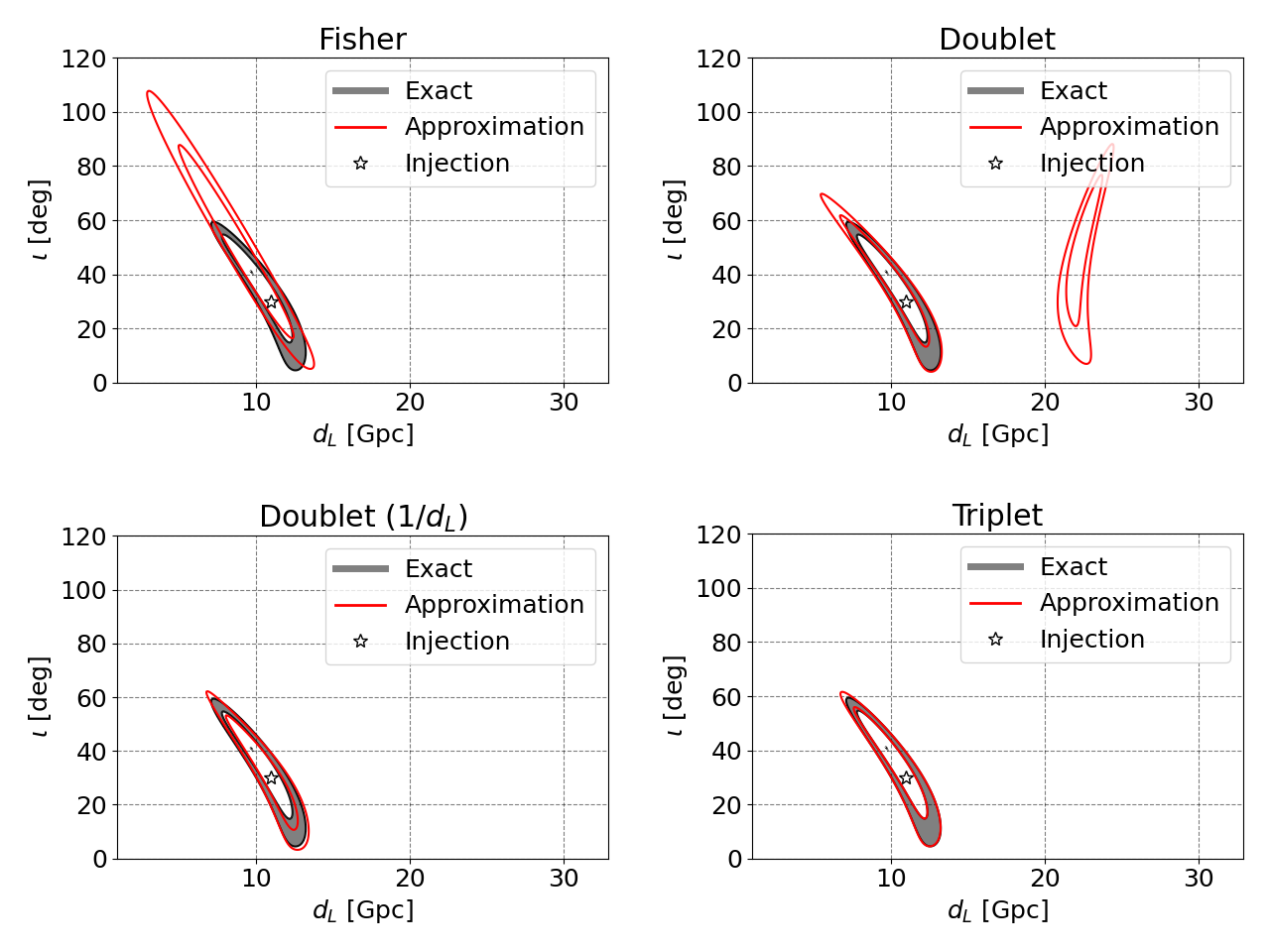
Software developed to perform parameter estimations of gravitational waves from compact objects coalescence (CBC) via Gaussian and Beyond-Gaussian approximation of GW likelihood [1,2]. The Gaussian approximation is related to Fisher Matrix, from which it is direct to compute the covariance matrix by inverting the Fisher Matrix [3]. GWDALI also deals with the not-so-infrequent cases of Fisher Matrix with zero-determinant, for instance, from Fisher Matrix inversion, the uncertainties of the luminosity distance \(\sigma_{d_L}(\iota)\) diverges for small values of source inclinations \(\iota\) (in contrast to what is shown in [4]). The Beyond-Gaussian approach uses the Derivative Approximation for LIkelihoods (DALI) algorithm proposed in [5] and applied to gravitational waves in [6], whose model parameter uncertainties are estimated via Monte Carlo sampling but less costly than using the GW likelihood with no approximation. Check our papers in arXiv:2307.10154 and arXiv:2510.16955.
Installation
To install the software run the command below:
pip install gwdali
Requirements
JAX
The new version of GWDALI uses JAX to accelerate the computation of waveforms and likelihoods as well as to compute derivatives via automatic-differentiation (autodiff).
We strongly recommend installing JAX with conda before installing GWDALI:
conda install -c conda-forge jax
Please make sure that JAX is installed before running pip install gwdali
Otherwise, pip will attempt to install JAX and its dependencies automatically, which may lead to issues with jaxlib on some systems. For more information, see the official JAX installation guide.
lalsuite/lalsimulation
To be able to use LAL waveforms to compute GW polarizations/strains install the packages lalsuite, lalsimulation. It is recommended to use conda.
conda install lalsuite -c conda-forge
conda install lalsimulation -c conda-forge
References
[1] de Souza, J. M. S., & Sturani, R. (2023). GWDALI: A Fisher-matrix based software for gravitational wave parameter-estimation beyond Gaussian approximation. Astronomy and Computing, 45, 100759.
[2] de Souza, J. M. S., & Quartin, M. (2025). On the use of the Derivative Approximation for Likelihoods for Gravitational Wave Inference. arXiv:2510.16955
[3] Finn, L. S., & Chernoff, D. F. (1993). Observing binary inspiral in gravitational radiation: One interferometer. Physical Review D, 47(6), 2198.
[4] de Souza, J. M. S., & Sturani, R. (2023). Luminosity distance uncertainties from gravitational wave detections of binary neutron stars by third generation observatories. Physical Review D, 108(4), 043027.
[5] Sellentin, E., Quartin, M., & Amendola, L. (2014). Breaking the spell of Gaussianity: forecasting with higher order Fisher matrices. Monthly Notices of the Royal Astronomical Society, 441(2), 1831-1840.
[6] Wang, Z., Liu, C., Zhao, J., & Shao, L. (2022). Extending the Fisher information matrix in gravitational-wave data analysis. The Astrophysical Journal, 932(2), 102.